
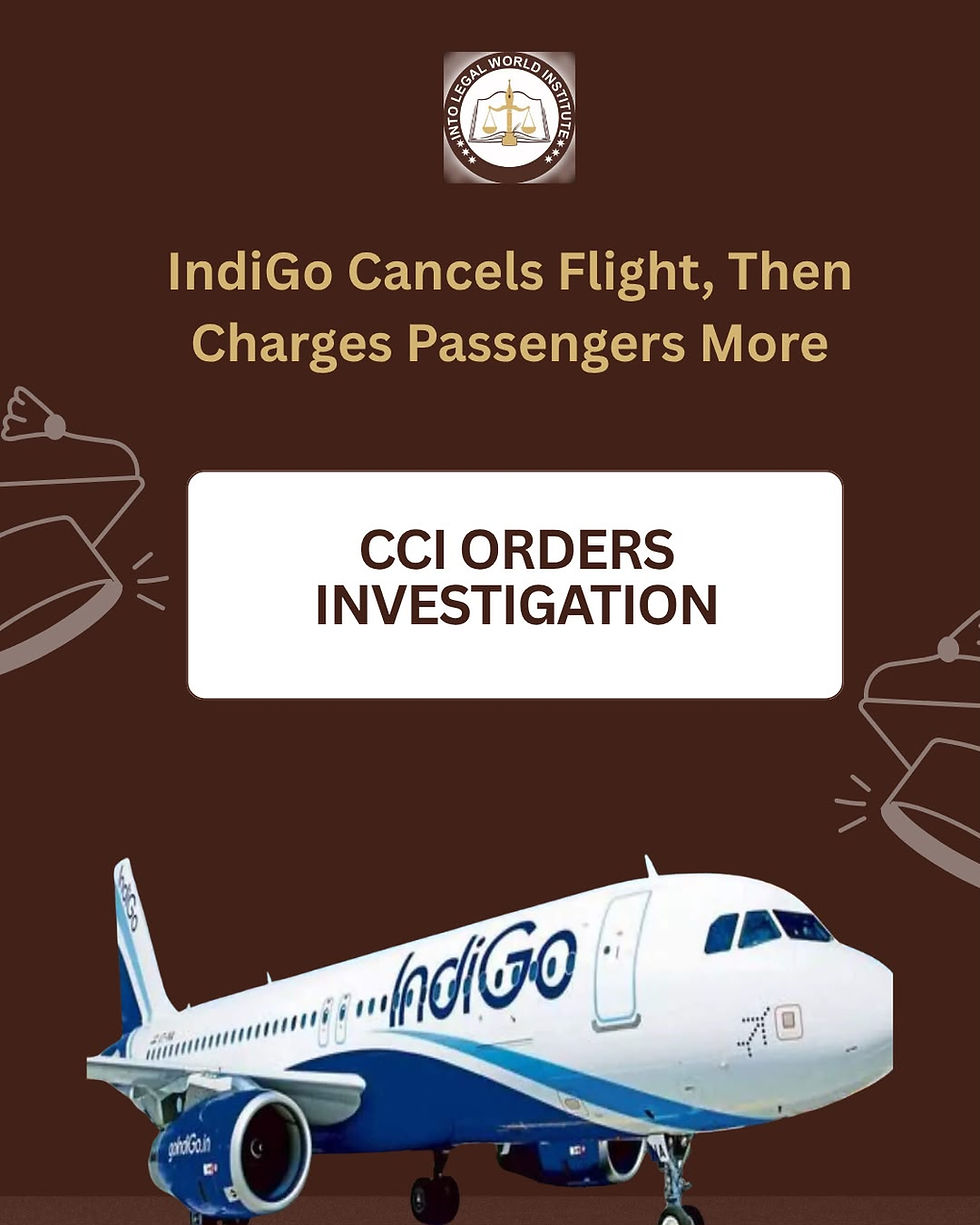
IndiGo Cancels Flight, Then Charges Passengers More: CCI Orders Investigation
In the first week of December 2025, IndiGo cancelled hundreds of flights overnight, leaving lakhs of passengers stranded across the country. One of them booked a Bengaluru–Delhi–Goa–Bengaluru round trip for ₹7,173. When IndiGo cancelled his return flight a few hours before departure, his only option on the same route was another IndiGo seat — for ₹17,000. He complained to the Competition Commission of India. On 4 February 2026, the Commission agreed he had a case, and ordered a full investigation into India's largest airline for abuse of dominant position.
What Actually Happened in December 2025
The disruption was not confined to one flight or one route. Across the first two weeks of December 2025, IndiGo cancelled 2,507 flights and delayed 1,852 more, affecting over three lakh passengers at airports nationwide. As seats vanished, fares on the very same sectors shot up — not just on IndiGo, but across the market, since rival airlines had limited capacity to absorb the sudden demand. The Ministry of Civil Aviation later imposed a ₹22.20 crore fine on IndiGo for the disruption itself. But the informant's complaint to the CCI raised a separate, sharper question: did IndiGo use its market power to cancel its own flights and then profit from the very scarcity it created?
IndiGo's First Move: “This Isn't Your Jurisdiction”
Before addressing the merits, IndiGo asked the CCI to step aside entirely. It argued that civil aviation already has its own comprehensive regulator — the Directorate General of Civil Aviation (DGCA), operating under the Bhartiya Vayuyan Adhiniyam, 2024 (BVA) and the Aircraft Rules, 1937 — and that this specialised regime impliedly excludes the CCI's jurisdiction over pricing and dominance complaints in aviation. It leaned on the Delhi High Court's ruling in Monsanto Holdings v. CCI and the Supreme Court's decision in Bharti Airtel v. CCI to make the point.
The Commission wasn't persuaded. It went back to what the Supreme Court actually said in Bharti Airtel: even when a sectoral regulator like TRAI examines the same conduct, its powers stay confined to that sector's statute — only the CCI can examine the same conduct through the lens of competition law. The Commission also got a reality check from the DGCA itself, which confirmed in writing that it has no economic regulatory powers over airfares and does not carry out market-dominance or anti-competitive-conduct analysis. With that, the jurisdictional objection collapsed.
How the CCI Built the Case That IndiGo Is Dominant
Before any conduct can be called “abusive,” the CCI first has to show the company is dominant in a defined market. Relying on data DGCA was directed to furnish, the Commission built its case on:
A market defined as “domestic air passenger transport services in India” — because the disruption hit routes and hubs nationwide, not just one city pair
IndiGo holding roughly 60–61% of domestic capacity (ASKM) across FY 2023–24 and FY 2024–25, rising to 63% passenger market share
Exclusive, sole-carrier status on more than 330 city-pair routes — out of about 835 routes nationwide
The only major Indian airline reporting sustained net profits in FY 2023–24 and FY 2024–25, while most rivals posted losses
The largest fleet in the country, at 400+ aircraft, more than double its nearest rival Air India's 191
On that basis, the Commission recorded a prima facie finding that IndiGo enjoys a position of dominance in the relevant market.
The Alleged Abuse: Cancel First, Then Overcharge
The CCI's order zeroes in on a specific pattern: passengers with confirmed, paid-for tickets were left with “no real choice” after last-minute cancellations, and were then forced to buy replacement seats — often from IndiGo itself — at sharply inflated fares. The Commission found this pattern raises a prima facie case under two limbs of Section 4 of the Competition Act, 2002:
Section 4(2)(a)(i) — imposing unfair or discriminatory pricing on consumers who, given IndiGo's dominance, were effectively locked in with no viable alternative
Section 4(2)(b)(i) — restricting the provision of services, by withdrawing scheduled capacity from the market and creating artificial scarcity during peak demand
Importantly, the CCI clarified that DGCA's tariff-monitoring power under Rule 135(4) of the Aircraft Rules — which lets the Director-General flag “excessive or predatory” tariffs — is corrective and supervisory in nature, and does not amount to a determination of abuse of dominance under competition law. The two regimes, the Commission held, address different objectives and can operate side by side.
What Happens Next
Under Section 26(1) of the Competition Act, the CCI has directed the Director General to investigate and submit a report within 90 days. The Commission was explicit that this order is only a prima facie finding — it is not a final verdict on IndiGo's guilt, and the DG has been told to investigate without being influenced by the observations already made. The case now moves from a paper complaint to a full-fledged CCI investigation, with IndiGo's actual conduct, agreements, and pricing data set to come under scrutiny.
Why Law Students and Lawyers Should Be Following This Case
This order is a textbook illustration of how competition law actually gets argued — market definition, the Section 19(4) dominance factors, the Section 4 abuse tests, and the sectoral-regulator-versus-CCI jurisdiction fight, all inside one order. For law students and young lawyers building a drafting and litigation practice, cases like this are exactly the kind of fact pattern worth mastering early. If you want structured training in drafting pleadings, replies, and applications across practice areas including competition, corporate, and civil litigation, ILW's Advanced Legal Drafting 6.0 course is built for exactly this — 12 drafting subjects, 500+ hours of recorded classes, 10,000+ downloadable drafts, and 1:1 mentorship, designed to take you from theory to courtroom-ready drafting.
Key Takeaways
A sectoral regulator's existence (here, DGCA) does not automatically oust the CCI's jurisdiction over the same conduct
Market share above 60% and exclusive presence on 330+ routes were central to the CCI's prima facie dominance finding
Cancelling capacity and then re-selling it at inflated prices can attract Section 4(2)(a)(i) and 4(2)(b)(i) simultaneously
This is a Section 26(1) order directing investigation — not a final finding of guilt against IndiGo
The DG's investigation report is due within 90 days of the order
Frequently Asked Questions
What is Section 26(1) of the Competition Act, 2002?
Section 26(1) empowers the CCI, once it forms a prima facie opinion that a contravention has occurred, to direct the Director General to investigate the matter and submit a report. It is an investigative order, not a final finding on merits.
Does the CCI have jurisdiction over airlines that DGCA already regulates?
Yes. The CCI held that DGCA's safety, licensing, and tariff-monitoring powers under the Bhartiya Vayuyan Adhiniyam and Aircraft Rules operate in a different field from competition law, and do not oust the CCI's jurisdiction to examine the same conduct for abuse of dominance.
What does “abuse of dominant position” mean under Section 4?
It means a dominant enterprise using its market power in ways listed in Section 4(2), such as imposing unfair pricing on consumers or restricting the production or provision of goods and services, which harms competition rather than merely competing on merit.
Is this CCI order a final verdict against IndiGo?
No. The Commission expressly stated that nothing in the order amounts to a final expression of opinion on the merits. It only directs the Director General to investigate and report within 90 days.
How did the CCI define the relevant market in this case?
The Commission defined it as “the market for domestic air passenger transport services in India,” reasoning that the December 2025 disruption affected passengers across multiple routes and hubs simultaneously, not just one origin-destination pair.
Keywords: CCI IndiGo order, abuse of dominant position IndiGo, Competition Act Section 4, CCI Case No. 44 of 2025, IndiGo flight cancellation CCI, DGCA jurisdiction competition law, competition law course India, Advanced Legal Drafting course
Stay updated with more case analyses and legal career content on ILW's WhatsApp Channel.
Read the full CCI order: Download the judgment (PDF) | View on Google Drive


Comments