
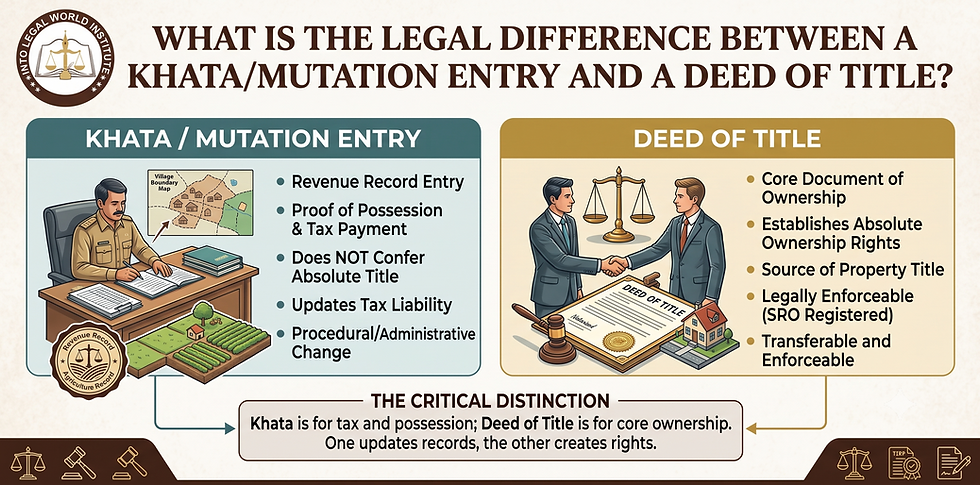
What is the legal difference between a Khata/Mutation entry and a Deed of Title?
- skaushal815
- Jul 25
- 4 min read

Confusing municipal tax records with actual ownership documents is one of the most common—and expensive—mistakes buyers, property owners, and young legal professionals make in real estate due diligence.
Let's break down what these documents mean, how Indian courts view them, and why confusing the two can derail a property deal.
What is a Title Deed?
A Title Deed (such as a Sale Deed, Gift Deed, Partition Deed, or Relinquishment Deed) is a formal legal instrument that creates, transfers, or confirms legal ownership of a property.
When a seller executes a registered sale deed in favor of a buyer under the Transfer of Property Act, 1882 and registers it under the Registration Act, 1908, ownership officially transfers.
Key Characteristics of a Title Deed:
Conclusive Proof of Ownership: It proves that you hold the legal right, title, and interest over the property.
Registered Document: Executed on non-judicial stamp paper and registered at the local Sub-Registrar Office (SRO).
Transfer Mechanism: Serves as the primary instrument whenever land or built-up property changes hands.
What is a Khata or Mutation Entry?
A Khata (commonly referenced in Karnataka/Bengaluru as A Khata or B Khata) or a Mutation Entry (known as Namantaran, Jamabandi, or Patta in various Indian states) is essentially an administrative record maintained by local revenue authorities or municipal corporations.
Its primary purpose is taxation and municipal administration—identifying who is liable to pay property tax for a given parcel of land or building.
Key Characteristics of Mutation/Khata:
Fiscal Purpose: It updates revenue registers to ensure the municipal body or revenue department sends property tax bills to the right person.
Administrative Record: Issued by local bodies (like BBMP, local Municipal Councils, or Tehsil revenue officers).
Does NOT Grant Title: The Supreme Court of India has repeatedly held that revenue entries, mutation entries, or khata updates do not create or extinguish ownership title.
Khata/Mutation Entry vs. Title Deed: A Side-by-Side Comparison
Feature | Title Deed (e.g., Sale Deed) | Khata / Mutation Entry |
Primary Purpose | Proves legal ownership & transfers property rights. | Assesses property tax liability for municipal/revenue registers. |
Issuing Authority | Executed between buyer & seller; registered at the Sub-Registrar Office (SRO). | Issued by Municipal Corporation, Revenue Dept, or Local Panchayat. |
Legal Evidentiary Value | High; primary evidence of ownership in a court of law. | Secondary/Presumptive; serves only as revenue/fiscal evidence. |
Statutory Governing Acts | Transfer of Property Act, 1882 & Indian Registration Act, 1908. | State-specific Municipal & Land Revenue Codes. |
Can it establish Title? | Yes. | No. Mutation entries follow title; they do not create it. |
The Legal Landmark: What the Supreme Court Says
The Supreme Court of India has reiterated this legal principle across dozens of judgments, notably in Bhimabai Mahadeo Kambekar v. Arthur Import & Export Co. and Suraj Bhan v. Financial Commissioner:
"Mutation of a property in the revenue record does not create or extinguish title to the property, nor has it any presumptive value on title. Such entries are relevant only for the purpose of paying land revenue."
In plain language: Just because a person’s name appears on the Jamabandi, Patta, or Khata certificate, it does not automatically make them the lawful owner if they lack a valid, registered title deed.
Why Understanding This Distinction Matters in Real Estate Due Diligence
Whether you are conducting title searches for banks, advising home buyers, or litigating land disputes, failing to verify both documents creates severe risks:
Buying from a Non-Owner: A seller might present a municipal Khata certificate showing their name, but if the property was acquired without a registered sale deed or through an invalid power of attorney, the deal can be declared void.
Missing Encumbrances: A title search requires tracing ownership back 13 to 30 years through registered deeds, not just checking the latest revenue entries.
Property Tax Default: Buying a property with a valid Sale Deed but without updating the Khata/Mutation entry leaves you unable to pay property tax or obtain building plan sanctions.
Take Your Property Law Expertise to the Next Level
If you are a law student, advocate, real estate consultant, or legal researcher, understanding land records, RERA compliance, title verification, and real estate litigation is one of the most lucrative skill sets you can build today.
To master end-to-end property due diligence—from examining 30-year search reports to navigating RERA provisions and municipal land records—explore the practical, industry-aligned Certificate Course in RERA & Legal Due Diligence by Into Legal World.
This comprehensive program gives you practical training in reading title deeds, identifying encumbrances, conducting title searches, and drafting due diligence reports with confidence.
Frequently Asked Questions (FAQs)
1. Is a Khata certificate proof of property ownership in India?
No. A Khata certificate is an administrative document used by municipal bodies to levy property tax. It indicates who is paying tax for the property, but legal ownership can only be established through registered title documents like a Sale Deed.
2. Can I sell my property using only a Mutation entry without a registered Sale Deed?
No. Legally transferring ownership of immovable property worth more than ₹100 requires a registered instrument under Section 54 of the Transfer of Property Act, 1882. A mutation entry alone is insufficient to transfer legal title to a buyer.
3. What happens if the name on the Title Deed and the Mutation Entry is different?
This usually happens when a property is bought or inherited, but the buyer fails to apply for revenue mutation. To rectify this, the title holder must apply to the local municipal or revenue authorities with the registered Title Deed to update the Khata/Mutation records.
4. Why do banks demand both Title Deeds and Khata/Mutation records for home loans?
Banks require the Title Deed to verify that the borrower is the rightful owner and can create a valid mortgage. They demand the Khata/Mutation records to confirm that the property is recognized by municipal authorities, has no tax arrears, and complies with local land regulations.
5. What is the difference between A Khata and B Khata?
In regions like Bengaluru, an A Khata indicates that the property adheres to all zoning laws, building approvals, and municipal regulations. A B Khata is an entry in a temporary register for properties with regulatory deviations or unapproved layouts, allowing the municipality to collect property tax without granting full statutory clearances.


Comments