
How to Enrol in Arbitration Law Classes Online in India
- Admin ilw
- Jun 27
- 11 min read

By Into Legal World · June 2026 · 9-minute read
Arbitration has quietly become one of the highest-value practice areas in Indian law. Every commercial contract has a dispute resolution clause. Every major infrastructure project, joint venture, real estate deal, and cross-border transaction has an arbitration mechanism built in. The courts have been actively pushing dispute resolution out of the traditional litigation stream and into arbitration for well over a decade now.
The result: demand for lawyers who actually understand arbitration — not just theoretically, but procedurally and practically — has grown faster than the supply. Law schools teach the Arbitration and Conciliation Act. Very few teach you how to draft an arbitration clause that actually works, how to frame a notice of arbitration, how to argue interim relief, or how to challenge an award. That is the gap that practitioners feel most acutely when they start handling real matters.
If you are a law student or advocate in India looking to enrol in an online arbitration law course in 2026, this guide covers everything — what arbitration practice actually involves, what an arbitration lawyer earns, how to find the right course, what to look for, and how ILW's Advanced Certificate Course in Arbitration & Dispute Resolution prepares you for real practice.
What Does an Arbitration Lawyer Actually Do?
Before choosing a course, it helps to understand what arbitration practice looks like day to day. Arbitration is not just another form of litigation with a private judge. It has its own procedural logic, drafting requirements, strategic considerations, and career pathways.
Drafting arbitration and dispute resolution clauses — every commercial agreement needs one, and a poorly drafted clause can invalidate the entire mechanism. This is one of the most common advisory tasks for arbitration lawyers at law firms.
Filing notices of arbitration and statements of claim — the formal commencement documents that establish jurisdiction, frame the dispute, and set up the arbitral tribunal.
Arguing interim reliefs — applications under Section 9 of the Arbitration and Conciliation Act before courts, and Section 17 applications before arbitral tribunals, for urgent injunctions and protection of assets.
Evidence and cross-examination — preparing witness statements, expert reports, and cross-examining witnesses during evidentiary hearings.
Award enforcement and challenge — applications under Section 34 challenging awards, Section 36 enforcement proceedings, and international enforcement under the New York Convention.
International commercial arbitration — handling disputes under institutional rules (ICC, SIAC, LCIA, DIAC, MCIA) and advising on seat, governing law, and enforcement strategy.
Advising on mediation and settlement — many arbitration matters settle during proceedings; knowing when and how to negotiate adds enormous value.
The arbitration specialist is one of the most sought-after profiles at Indian law firms in 2026. The salary data confirms it.
What Does an Arbitration Lawyer Earn in India? (2026 Verified Data)
Arbitration is among the highest-paying practice areas in India. Here is what the 2026 data shows:
Junior advocate in an arbitration practice (0–2 years): Rs. 4–8 LPA. Entry-level at dispute resolution boutiques and litigation chambers. Source: FindMyCollege Lawyer Salary Guide 2026.
Associate at a law firm with an arbitration practice (2–4 years): Rs. 8–18 LPA. Arbitration and dispute resolution specialists at Tier 1 and Tier 2 firms command a significant premium over general litigation associates. Source: LegalAlphabet India Legal Salary Guide 2026.
Senior associate at a Tier 1 arbitration practice (5–7 years): Rs. 25–35 LPA. Source: LawDrishti Law Firm Salary Guide 2025.
In-house arbitration counsel at a large corporate or infrastructure company: Rs. 15–30 LPA. Companies with significant contract portfolios — infrastructure, energy, real estate, manufacturing — maintain in-house arbitration teams. Source: LegallyIndia In-House Salary Data.
Independent arbitrator (10+ years, empanelled): Fees range from Rs. 50,000 to Rs. 5 lakh per session, depending on the matter and the arbitrator's standing.
International commercial arbitration specialist: Rs. 30 LPA to Rs. 1 crore+ depending on matter volume, institutional ties, and cross-border exposure.
The key insight from the salary data: arbitration specialists at boutique dispute resolution firms often reach parity with Tier 1 firm associates faster, and the path to being briefed as an arbitrator opens earlier than the path to partnership at a large firm. Specialisation in arbitration is one of the most reliable ways to accelerate earnings in Indian legal practice.
How to Enrol in Arbitration Law Classes Online in India
Online arbitration law courses in India vary enormously in quality. Before enrolling in any programme — free or paid, recorded or live — check these five things:
Faculty credentials: Are the instructors practising arbitration lawyers who currently handle live matters, or are they academics teaching from textbooks? Arbitration practice is highly procedural and strategic — you need someone who argued a Section 9 application last month, not someone who wrote about it in 2015.
Practical outputs: Does the course end with drafted documents — notices of arbitration, statements of claim, interim relief applications — or just lectures and certificates? A good arbitration course leaves you with a portfolio of real work.
Curriculum coverage: Does the course cover the full lifecycle of an arbitration matter — from clause drafting to award enforcement — or only selected parts? A complete programme should also cover mediation and the interface between arbitration and litigation.
Recognition: Is the course recognised by a government body, industry organisation, or reputable institution? Look for Skill India, IIT, or similar institutional backing.
Schedule: Weekend-only classes are essential for students and advocates who cannot commit weekday hours. Live sessions are significantly more valuable than recordings alone for arbitration training, because procedure and strategy are best learned through real-time discussion.
ILW's Advanced Certificate Course in Arbitration & Dispute Resolution
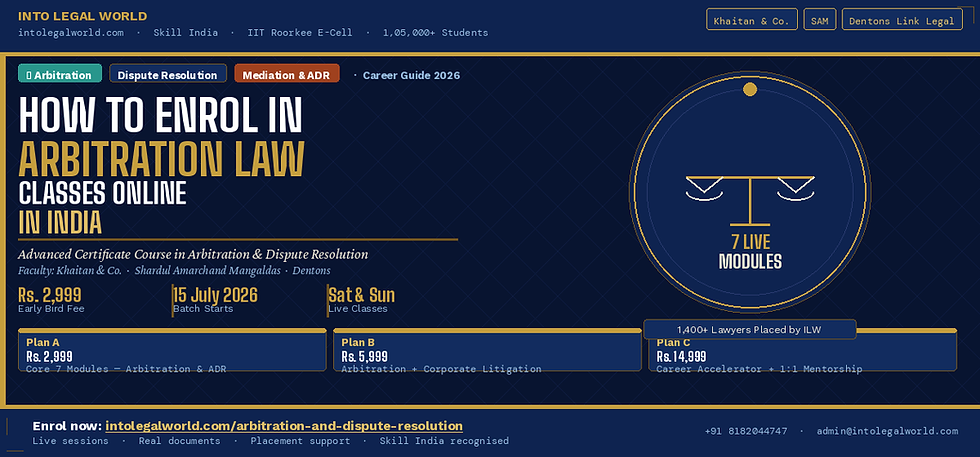
Into Legal World's Advanced Certificate Course in Arbitration & Dispute Resolution is a 7-module live online certificate programme covering the complete lifecycle of an arbitration and dispute resolution matter in India. It is taught by senior associates and practising lawyers from three of India's most active arbitration practices — and it is built to produce practitioners, not just certificate holders.
Batch starts: 15 July 2026 · Weekend classes (Sat & Sun) · Fee from Rs. 2,999 (students) — inclusive of GST
What the 7 modules cover:
Module 1: Commercial and Civil Disputes — Framework & Strategy. Understanding the types of disputes, how dispute resolution clauses are structured in commercial contracts, and how to choose between arbitration, mediation, and litigation as a strategic matter.
Module 2: Contractual Foundations & Dispute Clause Drafting. Drafting enforceable arbitration clauses from scratch — seat, governing law, institutional vs ad hoc, number of arbitrators, and how courts interpret and enforce (or strike down) poorly drafted clauses.
Module 3: Pre-Dispute Strategy & Legal Risk Management. Assessment of disputes before filing — legal risk analysis, evidence preservation, pre-arbitration negotiations, and building a strong factual record before proceedings commence.
Module 4: Initiation of Proceedings. Drafting and filing a notice of arbitration, statements of claim, and counterclaims. Understanding institutional rules (ICC, SIAC, LCIA, DIAC, MCIA) and ad hoc proceedings under the Arbitration and Conciliation Act 1996.
Module 5: Pleadings & Written Advocacy. Drafting written submissions, statements of defence, document production requests, and evidentiary applications. How arbitral tribunals read submissions differently from courts.
Module 6: Interim Reliefs & Urgent Remedies. Section 9 applications before courts and Section 17 applications before tribunals — when to file, how to draft, and strategy for emergency arbitrator proceedings.
Module 7: Hearing Practice, Award, Enforcement & AI Tools. Oral advocacy before arbitral tribunals, award enforcement under Section 36, challenges under Section 34, and New York Convention enforcement. AI tools in arbitration practice — legal research, document review, and drafting workflows.
Faculty — Senior Associates from India's Leading Arbitration Practices:
Ayush Srivastav — Senior Associate, Dentons Link Legal. 6+ years of experience in arbitration, litigation, and dispute resolution.
Nishant Doshi — Senior Associate, Shardul Amarchand Mangaldas. Dispute resolution specialist at one of India's top law firms.
Vishesh Sharma — Associate, Shardul Amarchand Mangaldas. Practising dispute resolution lawyer.
Abhishek P — Senior Associate, Khaitan & Co. Specialist in commercial litigation, arbitration, and mediation.
Mudit Marwah — Founder, Chambers of Adv. Mudit Marwah. Expert in criminal litigation, arbitration, and white-collar crime.
Three course plans available:
Plan A — Arbitration & Dispute Resolution Core: Rs. 2,999 (inclusive of GST). 7 live modules covering the complete arbitration and dispute resolution lifecycle.
Plan B — Arbitration + Corporate Litigation: Rs. 5,999 (inclusive of GST). Plan A plus commercial litigation strategy, interim reliefs, and enforcement.
Plan C — Dispute Resolution Career Accelerator: Rs. 14,999 (inclusive of GST). Plans A and B plus advanced legal drafting, freelancing strategy, and 1:1 mentorship.
Register now: intolegalworld.com/arbitration-and-dispute-resolution | WhatsApp: +91 8182044747
How ILW's Arbitration Course Translates Into Jobs and Career Growth
A certificate by itself does not build a career. What builds a career is demonstrated, practical competence. Here is how ILW's arbitration course creates real career outcomes:
Portfolio of real documents
Every module ends with a real deliverable — a drafted arbitration clause, a notice of arbitration, a Section 9 application, a statement of claim. By the end of the 7 modules, you have a portfolio of actual arbitration documents that can be shown at interviews, shared with potential clients, and used as templates in your practice. Most law students who apply for internships at dispute resolution practices cannot produce a single arbitration document. You will have seven.
Faculty connections to active practices
When your faculty includes senior associates from Khaitan & Co., Shardul Amarchand Mangaldas, and Dentons Link Legal, you are not just learning — you are building relationships with practitioners at the firms where you want to intern or work. Several ILW alumni have converted faculty interactions into internship referrals and full-time opportunities at dispute resolution practices.
Placement and internship support
All ILW course participants are added to a WhatsApp group where the ILW team actively shares internship openings, law firm vacancies, freelance arbitration drafting opportunities, and arbitral institution roles throughout and beyond the course. ILW has placed 1,400+ lawyers since 2018. Several ILW arbitration course alumni have gone on to intern at dispute resolution boutiques, the DIAC, MCIA, and major law firm arbitration practices in Delhi, Mumbai, and Bengaluru.
Recognition that employers respect
ILW certificates are issued under the recognition of the Skill India Initiative, Ministry of Corporate Affairs, IIT Roorkee E-Cell, Startup India, and the International Trade Council. When you list this on your CV or LinkedIn, it signals more than completion — it signals institutional backing and structured practical training.
What Makes ILW's Arbitration Course Different
There are several online legal education options in India. Here is what distinguishes ILW's arbitration programme — without naming anyone else:
Active practitioners, not academics or retired judges. Every ILW arbitration faculty member handled live arbitration matters last month. The course content is current, procedurally accurate, and rooted in how arbitration is actually practiced today — not in how it was practiced ten years ago.
Two-sided teaching methodology. ILW teaches you to draft a statement of claim as claimant's counsel and then teaches you to dismantle it as respondent's counsel. This dual perspective is what experienced arbitration lawyers develop over years. The course compresses it into structured live sessions.
Complete lifecycle coverage. Most online arbitration courses cover selected topics — drafting, or enforcement, or procedure. ILW's 7-module structure covers the complete arbitration matter from pre-dispute strategy through award enforcement and challenge proceedings. No gaps.
Live sessions, not just recordings. Arbitration strategy is learned through discussion, not passive viewing. Every ILW session is live, with real-time Q&A, case study discussions, and direct access to faculty. Recordings are available for revision but the primary learning happens live.
Affordable access. At Rs. 2,999 for Plan A, ILW's arbitration diploma is a fraction of the cost of comparable offline programmes in Delhi or Mumbai. The quality of faculty — Khaitan & Co., SAM, Dentons — is identical to what you would find in programmes costing ten times more.
Recognised under government programmes. Skill India, IIT Roorkee E-Cell, and Startup India recognition gives ILW certificates institutional weight that self-certified online courses cannot match.
Who Should Enrol in an Online Arbitration Law Course?
Law students from 3rd year onwards who want arbitration on their CV before graduation — especially those targeting dispute resolution practices or international law firms
Junior advocates who handle civil and commercial litigation and want to add arbitration to their practice without starting from scratch
In-house counsel at companies with significant contract portfolios — infrastructure, energy, real estate, manufacturing, fintech — where arbitration clauses are routine
Advocates who want to build towards empanelment as arbitrators over a 7–10 year horizon
Legal professionals interested in international commercial arbitration under SIAC, ICC, LCIA, or DIAC rules
Paralegals, company secretaries, and legal advisors who regularly work on contracts with arbitration clauses and want to understand the dispute resolution mechanism they are drafting
Frequently Asked Questions — Arbitration Law Courses Online in India
How do I enrol in an online arbitration course in India?
To enrol in ILW's Advanced Certificate Course in Arbitration & Dispute Resolution, visit intolegalworld.com/arbitration-and-dispute-resolution, select your plan (Plan A, B, or C), and register directly on the page. Payment is processed through Razorpay. For one-on-one counselling before enrolling, call or WhatsApp +91 8182044747. The course begins 15 July 2026 with weekend classes every Saturday and Sunday.
What is the best online arbitration course for law students in India?
The best online arbitration course for law students in India in 2026 is one that covers the complete arbitration lifecycle (not just selected modules), is taught by currently practising arbitration lawyers (not academics), requires you to produce real drafted documents at each stage, and is recognised under a government or institutional body. ILW's Advanced Certificate Course in Arbitration & Dispute Resolution meets all four criteria — 7 modules from clause drafting to award enforcement, faculty from Khaitan & Co., SAM, and Dentons, real document outputs at every module, and recognition under the Skill India Initiative.
What is the salary of an arbitration lawyer in India?
Arbitration lawyers in India earn among the highest salaries in the profession. In 2026: junior associates at arbitration practices earn Rs. 4–8 LPA; mid-level associates at Tier 1 firms with arbitration specialisation earn Rs. 8–18 LPA; senior associates earn Rs. 25–35 LPA; in-house arbitration counsel at large corporates earn Rs. 15–30 LPA; independent arbitrators charge Rs. 50,000 to Rs. 5 lakh per session; and international arbitration specialists earn Rs. 30 LPA to Rs. 1 crore+ depending on matter volume and institutional ties. Sources: FindMyCollege Lawyer Salary Guide 2026, LegalAlphabet India Legal Salary Guide 2026, LawDrishti Law Firm Salary Guide 2025.
Can I do an arbitration course while studying LLB?
Yes. ILW's arbitration course is specifically designed for law students who are currently enrolled in LLB or BA LLB programmes. All classes are held on weekends (Saturday and Sunday evenings) so they do not conflict with college schedules. The course is fully online and accessible from any city in India without relocation.
Is an online arbitration certificate course recognised in India?
ILW's certificate in Arbitration & Dispute Resolution Practice is recognised under the Skill India Initiative (Government of India), Ministry of Corporate Affairs, IIT Roorkee E-Cell, Startup India, and the International Trade Council. It is suitable for CV documentation, LinkedIn profiles, Bar Council continuing education, and professional development. Many ILW arbitration course alumni have listed the certificate in their profiles and used it to secure internships and roles at dispute resolution practices.
Does the arbitration course cover international commercial arbitration?
Yes. Module 7 of ILW's arbitration course includes an overview of international commercial arbitration — key institutional frameworks (ICC, SIAC, LCIA, DIAC, MCIA), seat and governing law considerations, strategic differences between domestic and international proceedings, and how Indian practitioners engage with and appear in international arbitration. The course also covers New York Convention enforcement for cross-border awards.
What is the difference between arbitration and mediation? Does the course cover both?
Arbitration results in a binding award imposed by the arbitral tribunal. Mediation is a facilitated negotiation process where the parties reach a consensual settlement with the assistance of a neutral mediator. Both are forms of Alternative Dispute Resolution (ADR). ILW's course covers the full dispute resolution spectrum — the strategic choice between arbitration, mediation, and litigation is covered in Module 1, and negotiation and settlement strategy (including mediation) is covered in Module 6.
How does ILW help students get jobs after the arbitration course?
ILW supports placement in three ways: (1) All course participants join a WhatsApp group where ILW actively shares internship openings, law firm vacancies, freelance arbitration drafting opportunities, and arbitral institution roles throughout the course and beyond. (2) Faculty from Khaitan & Co., SAM, and Dentons provide mentorship that has led to internship referrals for several alumni. (3) The portfolio of real arbitration documents produced during the course is directly usable in interviews — most candidates applying for arbitration internships cannot produce a single drafted document; ILW participants produce seven.
About Into Legal World
Into Legal World (ILW) is a unit of Parivritt Enterprises Pvt. Ltd., recognised under the Skill India Initiative, Ministry of Corporate Affairs, Government of Uttar Pradesh (UPLC), International Trade Council, IIT Roorkee E-Cell, and Startup India. ILW has trained over 1,05,000 law students and legal professionals since 2018, with 1,400+ lawyers placed in law firms, in-house roles, and independent practice across India.
Website: intolegalworld.com · +91 8182044747 · admin@intolegalworld.com


Comments