
How to Register a Marriage in India: Step-by-Step Guide under Hindu, Muslim, Christian, and Special Marriage Acts
- shwetasabuji
- Jul 18, 2025
- 4 min read
AUTHOR : Veronica John-Francis
Introduction
In India, marriage is not just a union of two individuals, but a religiously ordained socio-cultural construct. Historically, weddings and marriages were also seen as contract, all without documentation. As society changed and legal institutions grew, marriage registration has become an essential practice to secure legal rights and social support. In a country as diverse as India, marriage laws are regulated by a plethora of personal and religious laws. Customary practices are still very important, but purely statutory registration is very important in ensuring civil rights and social justice, in matters of divorce, succession, inheritance, and maintenance in particular. A secular model for inter-faith and civil marriages is made available under the 1954 Special Marriage Act. The information presented in this article provides a detailed overview of the registration of marriage in India according to different acts, such as the Hindu Marriage Act, Muslim Personal Law, Christian Marriage Act, and Special Marriage act.
Marriage Registration in India (Online)
Due to technological and digital advancements, marriage registration can be started online in many states across India. You can do this by going to the official website of the State Government in which you reside in and find the link for the marriage registration form, you will need to enter your details and submit it online. On receipt of the same, the Marriage Registrar fixes a date for verification in person. The couple is required to go with two witnesses and original documents to the registrar’s office for the marriage.For marriages under the Hindu Marriage Act, the registration is usually completed within a span of 15–30 days. Under the Special Marriage Act, the process takes around 60 days due to mandatory public notice period.The documents required for marriage registration include age and residence proof, passport-sized photos, marriage invitation card (if applicable), certificate of solemnization, and affidavits regarding marital status and nationality. In case of divorce or widowhood, relevant legal documents must be submitted. Two witnesses from each side must also be present.
Hindu Marriage Act, 1955
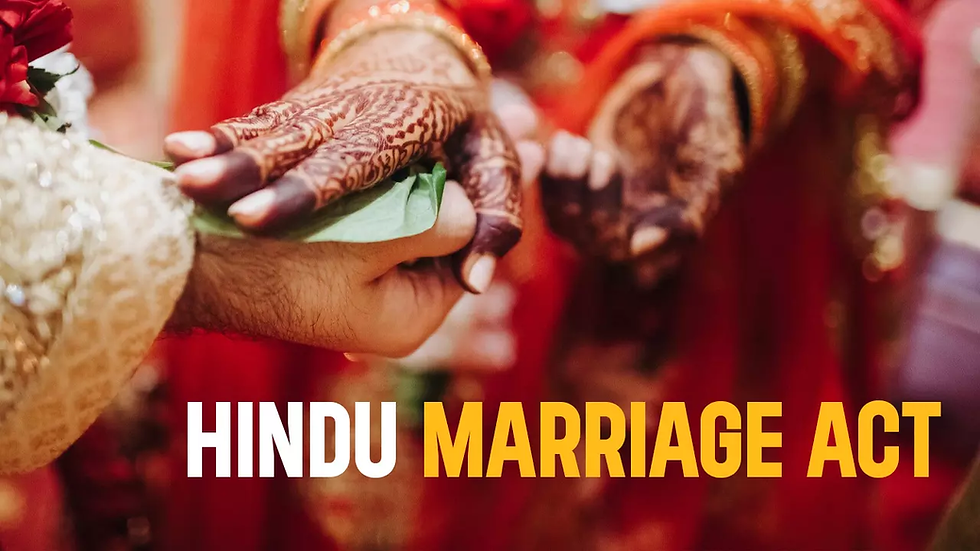
Under Section 7 of the Hindu Marriage Act, a Hindu marriage is considered valid when solemnized through customary rites of either party. One of the mandatory rituals is the ‘Saptapadi’—the seven steps around fire—which signifies the completion of the marriage upon the seventh step. Section 8 of the Act deals with registration of the marriage. Although registration is not mandatory it is advisable for legal validity and recognition. States make rules for appointing marriage registrars and maintaining marriage registers. These registers serve as an admissible evidence in court of law.
Section 3 defines the degrees of prohibited relationships. Marriages are void if solemnized between persons in such relationships, including lineal ascendants/descendants, siblings (full, half, or uterine), and relatives by marriage such as a deceased sister’s husband. Thus, marrying one’s deceased sister’s husband is prohibited.Seema v. Ashwani Kumar (2006) is a landmark supreme court case that emphasized the necessity of marriage registration in all religions in India to prevent child marriage, bigamy, and human trafficking, and directed all states to make marriage registration compulsory.
Muslim Personal Law
Islam considers marriage or ‘Nikah’ as both a civil contract and a religious act. It mandates mutual and free consent of both parties, the presence of two adult witnesses, and an offer and acceptance (Ijab-o-Qubool). A fixed dower (Mahr) is also an essential component. According to the Muslim Marriage Registration Act, 1981, registration is compulsory and must be done within 30 days of the Nikah ceremony. The Nikahnama records details such as the bride and groom’s names, addresses, marital status, dower amount, witnesses, and the officiating Qazi. Sunni and Shia interpretations of marriage and its rituals differ, with Shia law also recognizing temporary marriages (Muta), while both sects emphasize the legal sanctity of marriage as a contract.
Christian Marriage Act, 1872
Christian marriages in India are governed by the Indian Christian Marriage Act, 1872. The process requires a notice of intended marriage submitted to the Marriage Registrar, followed by a 30-day waiting period. Marriages must be solemnized in a church or registrar’s office and certified by a licensed minister or registrar. The law prescribes a minimum age of 21 years for men and 18 years for women. The presence of witnesses and submission of declaration forms are also mandatory.
Special Marriage Act, 1954
The Special Marriage Act allows any two persons, regardless of religion or caste, to marry legally. It is particularly useful for interfaith and inter-caste couples seeking a civil union without having to marry under a personal law. The process begins with filing a notice of the intended Marriage at the office of the Marriage Officer in the district where at least one party has resided for 30 days. This notice is then published for 30 days to invite objections. If none are received, the marriage is solemnized at the registrar’s office in the presence of three witnesses.The Act sets out basic conditions for a valid marriage such as, no existing marriage for either of the parties, mental capacity to consent, minimum age of maturity(21 for men, 18 for women), and absence of prohibited relationships. These prohibited degrees include lineal ascendants or descendants, siblings, uncle-niece, aunt-nephew, and children of siblings.
Conclusion
In a diverse and culturally rich country like India, where marriage is both a sacred bond and a legal contract, this makes it more important that ever to make it legally and formally valid and recognized. While religious and customary rituals preserve the heritage and sanctity of marriage, legal registration gives it enforceable legitimacy in the eyes of the law. A registered marriage protects spouses, especially women from exploitation and secures inheritance and matrimonial rights, and it also simplifies documentation in legal, financial, and social matters. Whether it is solemnized under the Hindu, Muslim, Christian, or Special Marriage Act, registration ensures transparency, certainty, and fairness. In today’s evolving society, where interfaith, inter-caste, and non-traditional unions are increasingly common, legal safeguards must be taken hand-in-hand with tradition. Marriage registration is not just a bureaucratic formality, it is a critical step towards justice, empowerment, and social security in every marital relationship.


Comments