
Cyber law in India—A Beginner's Guide
- skaushal815
- Feb 16
- 4 min read

Author- Abhyuday Pratap Singh
Introduction
In India over 800 million people are using the internet for their banking, social media, and other payment facilities to live their daily lives fluently. But this rapid change has also triggered new types of offenses or crimes that are being committed online on the surface of the Internet, and in order to protect and regulate the Internet world, the cyber law has been enacted by the legislature of our country. Just as physical society needs laws to maintain order, the digital realm requires a legal framework to govern conduct and protect users. This framework is known as cyber law.
For a beginner, cyber law can be understood simply as the "law of the internet." It is the branch of law that deals with legal issues related to the use of networked information technology. It covers a wide spectrum of activities, including electronic commerce, intellectual property in cyberspace, data protection, and cybercrime. In India, the foundation of this legal structure is the Information Technology Act, 2000 (IT Act). Understanding the basics of this act is essential for every digital citizen to navigate cyberspace safely and legally.
Meaning and scope of Cyber law
Cyber law is a path of rules that governs the internet. It is just like the laws for regulating the physical world, and cyber law is similar to it, and it ensures public safety and digital theft. Cyber law is a legal framework that provides safety to an individual and protects its rights and governs the computers, smartphones, and other digital documents that are uploaded on the internet.
Cyber law plays a crucial role in protecting the online transactions done by an individual on a website, payment applications, or money transfers to a bank; it also ensures that there is legal validity. It extensively targets cyber crimes and establishes strict definitions and penalties for frivolous activities like hacking, spreading computer viruses, identity theft, and online harassment. Companies and organizations are forced to handle your information responsibly and also ensure its protection, ensuring that your photos, passwords, personal details, and financial details are not encrypted or shared publicly without the consent of the owner.
Therefore, cyber law gives a modernization to the legal system by giving a recognition to the electronic document and signatures. It ensures that a PDF, digital contract, or email receipt gets its legal validity as equivalent to the traditional legal document that is used in the court proceedings. Nevertheless, without the cyber law, the internet would be a disaster, a "wild west"; instead of that, it provides the structure necessary for us to trust technology and use it confidently in our daily lives.
The Cornerstone: The Information Technology Act, 2000
Before the year 2000, India’s legal system was primarily designed for a paper-based society. Contracts required physical signatures, and evidence in court usually meant hard copies of documents. The internet disrupted this status quo. Recognizing the urgent need to recognize electronic commerce and digital communication legally, the Indian Parliament enacted the Information Technology Act, 2000.
It is important to note that India did not create this law in isolation. The IT Act was largely based on the Model Law on Electronic Commerce adopted by the United Nations Commission on International Trade Law (UNCITRAL) in 1996. The primary objective of the IT Act was to provide "legal recognition" for transactions carried out by means of electronic data interchange and other means of electronic communication.
In simpler terms, the IT Act made digital signatures as legally valid as handwritten ones. It ensured that electronic records like emails or digital account statements could be admissible as evidence in a court of law. This was a revolutionary step that enabled the growth of e-commerce and e-governance in the country.
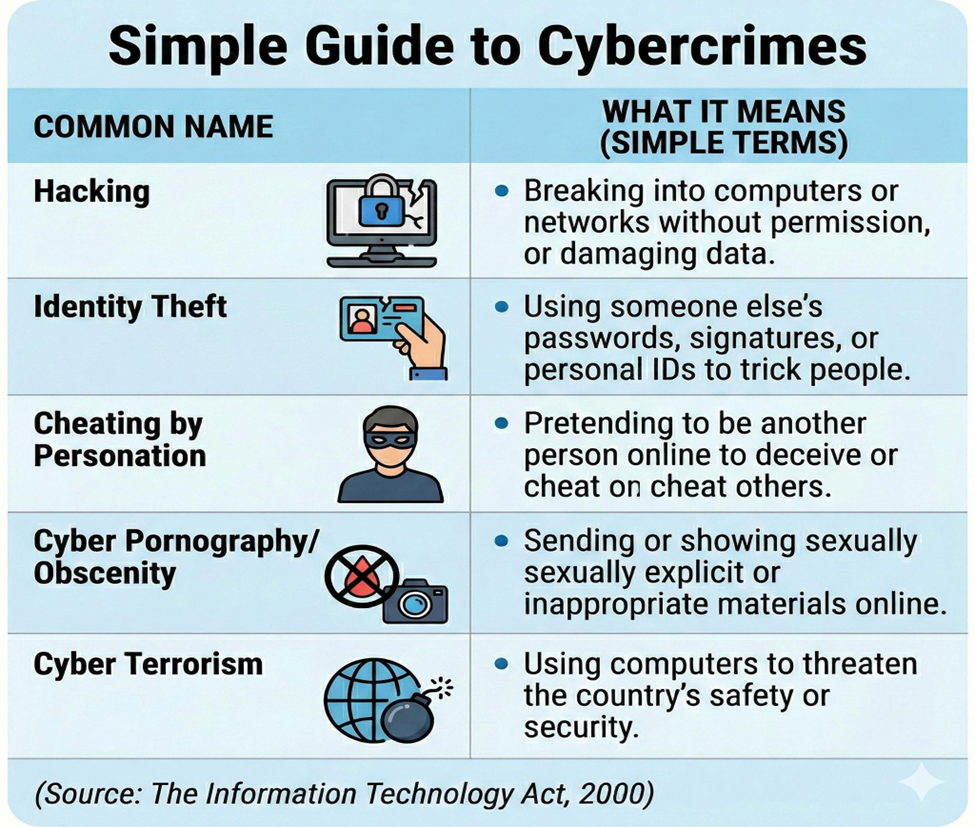
Understanding Cyber Crimes and Punishments
While facilitating e-commerce was the primary goal, the IT Act also had to address the darker side of the internet: cybercrime. The original Act was significantly amended in 2008 to broaden definitions and introduce stricter penalties for various digital offenses.
For a beginner, it is crucial to recognize that actions that are illegal offline are often also illegal online. However, the IT Act specifically targets crimes committed using computers and communication devices.
These provisions show that the law takes digital trespass and fraud seriously. For instance, under Section 66F concerning cyber terrorism, the punishment can extend to life imprisonment, reflecting the severity with which the state views threats to national security launched from cyberspace.
The New Frontier: Data Privacy and the Future
While the IT Act, 2000, remains the bedrock of Indian cyber law, the digital landscape has changed drastically since its inception. The biggest modern challenge is not just hacking, but the massive collection and misuse of personal data by corporations and bad actors.
For years, India lacked a dedicated, comprehensive data privacy law. Data protection was loosely governed by certain rules under the IT Act (specifically the SPDI Rules of 2011). However, this changed dramatically with the introduction of the Digital Personal Data Protection Act, 2023 (DPDP Act).
Though the government is still framing the detailed rules for its implementation at the time of this writing, the DPDP Act represents a paradigm shift. It centers on the rights of the individual (termed the "Data Principal") and imposes heavy obligations on companies that collect data (termed "Data Fiduciaries"). For a beginner, the key takeaway of this new law is "consent." Companies will now need clear, free, and specific consent before processing personal digital data, and hefty penalties are proposed for breaches of user privacy.
Conclusion
Cyber law in India is not a static subject; it is an ever-evolving field that races to keep pace with technological advancements. What was sufficient in 2000 was inadequate by 2008, and today, we see entirely new legal frameworks emerging for artificial intelligence, cryptocurrency, and data privacy. For the average user, becoming an expert is not necessary, but basic awareness is vital. Understanding that the digital world has concrete legal boundaries is the first step toward being a responsible and secure digital citizen in India.
References
The Information Technology Act, 2000 (India).
United Nations Commission on International Trade Law (UNCITRAL)
Model Law on Electronic Commerce with Guide to Enactment 1996.


Comments