
FUNDAMENTAL DUTIES: WHY CITIZENS HAVE CONSTITUTIONAL RESPONSIBILITIES TOO
- skaushal815
- Feb 16
- 5 min read

Author- Zulaika Afthaz
Introduction
NSA Ajit Doval Sir once mentioned in his speech that “If you have everything but you do not have morals, then all your weapons will be useless." In the constitutional context of India, these ideas of moral and morale find structured expression in the fundamental duties under Part IV of the Indian Constitution. Oftentimes, we tie the idea of following morals and values and fulfilling duties just to the Indian Armed Forces and soldiers. In our eyes, they are the only people who are bound to fulfill their duties, but in conscious democracy, such morale is not restricted to military capacity alone, but it extends towards the citizens of the nation too.
If we look at the current mindset of the citizens over rights and duties, we can see people demanding their rights, voicing out about it, conducting webinar sessions, protesting over it, and social media outrage over the violations of rights. But most of the time, a complete silence over the civic responsibilities. Hypocrisy is when citizens protest over an issue—let's suppose over demanding these rights—and let’s suppose over-demanding their rights, and with extreme hatred, they damage the public property without even realizing that they are entitled to protect it first as a fundamental duty, even before demanding their rights. But the question still remains: can a constitutional democracy survive if citizens only demand and never contribute?
Moral Strength, Legal Weakness
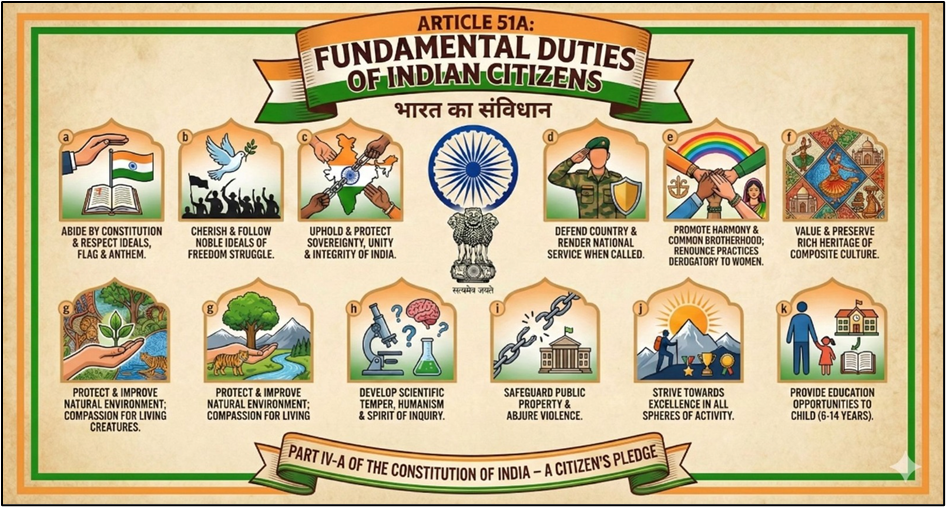
The concept of Kartavya, performing duty by an individual towards society as a whole, was prominent in ancient literature like the Ramayana and the Bhagavad Gita. Chapter 2, verse number 47, “karmaṇy-evādhikāras te mā phaleṣhu kadāchana,” which means “Do your duty, and the rest is up to God.” All of these emphasize the duty of an individual towards society from ancient times. In modern times, we know these duties in the Indian context as fundamental duties, which were implemented through the 42nd Amendment Act. It includes 10 fundamental duties in Article 51A, and one more duty was added in 2002 through the 86th Amendment.
Let's take an example of the helmet law. What is the main reason for implementing the compulsory wearing of helmets while traveling on two-wheelers? The safety of the individuals and rather to protect the lives of thousands of people from road accidents. But people think that fining for not wearing a helmet is a new means of making money for enforcement agencies. They wear helmets just to avoid the fine. In the same way, citizens follow laws with the fear of punishment, but not because of whether they are morally right or wrong to do so. So, it is evident that as long as these fundamental duties are not enforceable by law, citizens won't even care about knowing them, let alone following them sincerely.
Systemic Inconsistency
We cannot say that enforcing them through law is the only option left. The makers of the law didn't make them unenforceable for a reason. As the saying goes, “Power corrupts, but absolute power corrupts absolutely." Enforcing these duties might give absolute power to administrative authorities to have greater control over the citizens' choices. And especially when it comes to duties, it must be left for the conscience of the citizens to choose whether to follow them or not.
We cannot fully blame citizens for the same. In a country where we often see delayed justice for serious crimes or weak enforcement of strict laws, fundamental duties cannot even stand in that race. And even civil education, which must be taught in schools, is restricted to theoretical rather than practical aspects. The respect for national symbols often becomes performative for one day rather than sincere. The religious harmony is misused, and divisions are created for political motives. All these aspects point towards the fact that citizens cannot be expected to perform duties out of their choice in a system where accountability from government institutions themselves appears inconsistent.
Risk of Over-Enforcement
At the same time, we cannot encourage the over-enforcement of these fundamental duties too. In the national anthem case, it was clear that patriotism cannot override individual consciences; strict enforcement may empower the state excessively and create forced nationalism, which again will invite citizens’ hatred towards the nation rather than pride and love towards it. Thus, there is a thin layer, a thin line, between encouraging civic discipline and over-enforcing the duties, and patriotism must remain voluntary in order for it to remain meaningful.
Reform-Oriented Framework
Instead of blind enforcement, the law must include some of the reforms to ensure that these duties are followed voluntarily by the citizens. Institutional accountability must be built through stronger transparency laws and visible punishment for corruption so that it can work as a role model for citizens to follow. Legal literacy programs and workshops must be conducted in villages and cities, giving awareness about fundamental duties. A community cleanup drive where people gather one day a week or month to clean water sources and surroundings, practical simulations for children in schools as to how to follow duties and request elders to do so, strengthening environmental penalties for not maintaining cleanliness in heritage centers and tourist places, and implementing minimal fines for damaging public property. Expansion of the National Cadet Corps and disaster relief training for every citizen to inculcate a service mindset among every individual so that they will be ready not just with the mindset but with the skills to defend the nation when called upon to do so.
Conclusion
Redefining patriotism from symbolic, such as hosting the flag on national holidays, to a substantive one where citizens can follow lawful conduct, comply with the tax laws, and live in harmony with everyone else within the nation. Duties were meant to cultivate the culture of following morals, values, and laws. This culture cannot be regulated or enforced, but it can be modelled. A republic nation survives not by fear, but by the shared responsibility of every individual in a society.
REFERENCES
1. NSA Ajit Doval, ‘Ajit Doval Addresses India's Youth in a Powerful 'History' Lesson’ (Republic World, 10 January 2026) <https://youtu.be/on1oXJ1FuLk?si=0Zxm-HT9sRlf5exG> accessed 14 February 2026
2. Constitution of India 1950, art. 51A.
3. Constitution (Forty-Second Amendment) Act 1976.
4. Constitution (Eighty-Sixth Amendment) Act 2002.
5. Homa Bansal, ‘The Importance of Fundamental Duties for India's Unity and Development’ (2023) Panjab University Law Review, 61(2), 172-185
6. Mukesh & Anr v. State for NCT of Delhi & Ors, AIR 2017 SC 2161
7. Bijoe Emmanuel v. State of Kerala, AIR 1987 SC 748
8. Ministry of Local Government, ‘Umuganda, a path to self-reliance of Rwandans’ (2025) <https://www.minaloc.gov.rw/news-detail/umuganda-a-path-to-self-reliance-of-rwandans> accessed 14 February 2026
9. Steve John Powell & Angeles Marin Cabello, ‘What Japan can teach us about cleanliness’ BBC (7 October 2019) <https://www.bbc.com/travel/article/20191006-what-japan-can-teach-us-about-cleanliness> accessed 14 February 2026
10. Acton Institute, ‘Lord Acton Quote Archive’ (n.d.) <https://www.acton.org/research/lord-acton-quote-archive> accessed 14 February 2026


Comments